Chapter Two: Studio Gear

3. Microphones
Overview
Microphones (typically shortened to mics—not spelled, but pronounced mikes) are a type of transducer, turning minute changes in air pressure into equivalent fluctuations of electrical current. They are in some sense the opposite of loudspeakers, which do the same in reverse. In fact, if you were stranded on a desert isle with only a speaker, you could use it as a microphone, mimicking a moving-coil type of mic. Composers, while not needing the same level of expertise in mic'ing that audio engineers do, need to learn as much as possible if they are recording sound samples for their compositions. Poorly recorded sound files only get worse when manipulated during the compositional process—you cannot erase excessive room ambience, or distortion, or phase cancellation caused by poor time alignment, or the choice of the wrong mic pattern for a particular task. In addition, concert setups for electroacoustic works that involve live processing and/or amplification of performers also require knowledge of proper mic selection and placement. Below, we will discuss some of the basics of microphones and mic'ing techniques.
Parts of a microphone
Body: the body holds all the components listed below: the electronics, protective screen, acoustic baffles and/or physical isolators, as well as the connector (usually male XLR for pro mics).
Diaphragm: the microphone equivalent of your eardrum, in that it is a small (0.2" to 1.5"), usually circular piece of super-thin material (such as Mylar) that vibrates sympathetically when sound waves interact with it. It is attached directly to the transducing mechanism that produces electrical signals, as in the case of a condenser mic, or it is physically attached to something else that produces the fluctuating current, as in a moving-coil microphone. Mics with diaphragms approximately 1" or larger are referred to as large-diaphragm mics, which are almost always side-address.* They have, in general, higher sensitivity, lower self-noise, and a slower transient response, along with more off-axis coloration. A flat, "balanced" frequency response is more characteristic of small-diaphragm mics. Microphones that work on the pressure-gradient principle, which include virtually all directional mics, will have both sides of their diaphragms open to external sound pressure, some with sound entering from behind coming through a time-delaying acoustic channel called a labyrinth.
Capsule: sometimes called an element, the capsule holds the diaphragm, a stationary backplate, a diaphragm tensioning ring, and the diaphragm housing. In addition, it contains the electrodes that conduct the current to the mic electronics or output, attached to either the center or edge of the diaphragm, which affects its low- and high-end response. Edge-terminated capsules tend to have more extended low- and high-frequency response, while center-terminated capsules give a more controlled, predictable response and are more resistant to plosive overload. Some microphones mount two diaphragms back to back within a single capsule, allowing the mic to be switched among multiple directional patterns by varying the polarizing voltage on the rear diaphragm (e.g., AKG C414, Neumann U 87). Other microphones are sold with two or more interchangeable capsules for different response patterns. Ribbon microphones do not technically have capsules, but instead have a thin corrugated aluminum ribbon suspended between the poles of a strong magnet.
Ports or vents: the opening(s) in the microphone to let the sound waves in, often covered by a protective grille. Some ports allow sound in behind the diaphragm, as mentioned above. While most microphones are described as front address—meaning the diaphragm is perpendicular to the long axis of the microphone, facing out its end, and the front of the microphone is pointed toward the source—some microphones, particularly those designed for stereo pairing, are side address, where the diaphragm is parallel to the sides, and vents are located on one or both sides of the microphone. AKG C414s and Neumann U 87s are side-address, and they can receive sound from both front and back.
Windscreen: a removable microphone accessory, often made of foam and slipped onto the microphone. It is designed to reduce the low-frequency rumble produced by wind blowing across a microphone's grille or port. For frequent outdoor recording, a large all-enclosing version of this is called a blimp or zeppelin, and the ragged artificial fur appearance of some models has led to the nomenclature "dead cat" or "dead kitten." Windscreens are also handy for keeping spit out of your expensive mic and making presidents look important, but pop filters, which stand off farther from the mic, are better suited to reducing speech plosives.
Shockmount: a clip (sometimes called a spider mount) attached to a mic stand that holds the mic in a cradle of elastic bands, springs or other flexible material to keep low-frequency vibrations (called rumble)—from such sources as passing trucks, HVAC, and foot tappers—from traveling up the stand from the floor. These often come custom-fit to specific microphone models.
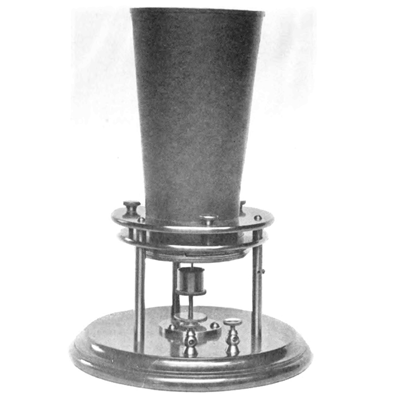 Floyd L. Darrow/public domain
BELL LIQUID TRANSMITTER
Alexander Graham Bell invented this improved telephone transmitter, essentially a microphone, which has a fine charged wire attached to a parchment diaphragm. The wire dips down into a brass cup containing a mild acid solution that forms the other end of the circuit. Vibrations of the diaphragm cause the wire to rise and fall in the acid, thereby creating an oscillating current as the circuit's resistance changes.
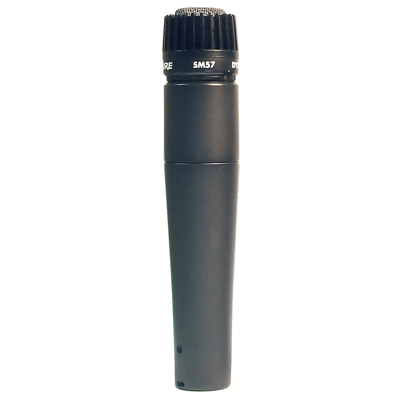
SHURE SM57 FRONT ADDRESS MICROPHONE
The Shure SM57 is still the most widely used microphone in the world, along with its sibling, the SM58, which is more suited to vocal sources. A dynamic microphone with a cardioid pattern and a balanced output, it was released in 1965 and has been used in pairs for virtually every U.S. presidential address since, along with its iconic windscreen.
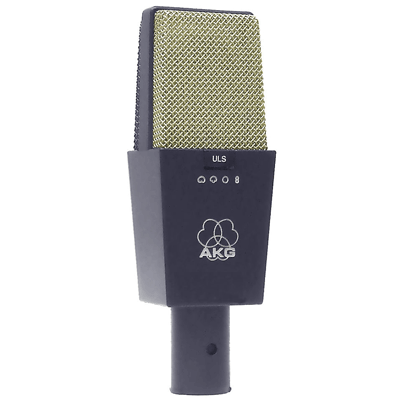
AKG C414 SIDE ADDRESS MICROPHONE
The AKG C414 microphone, still in wide use, is a large-diaphragm condenser microphone. It is extremely flexible in the studio because it offers multiple polar pickup patterns that are easily switchable. It was first released in 1971. Successive C414 models have brought electronic switching, better handling of high SPLs, and a lower noise floor.

