Chapter One: An Acoustics Primer
13. What are standing waves?
A particular pattern of constructive and destructive interference is called a standing wave. Standing waves are essential essential to the way most musical instruments produce sound, but very undesirable in the listening environment of an electronic or recording studio.
The prior examination of constructive and destructive interference, along with concepts of reflected phase, comes into play. When two traveling waves propagate in opposite directions inside a bounded system — a tube, a string, or a room — their interference produces a resultant wave that appears to stand still at certain resonant frequencies called modes. These modes generally correspond to harmonic partials, with the first mode producing the fundamental. In a listening environment, these are called room modes, and the result is that certain frequencies are unduly enhanced or suppressed at different locations in the room.
String Modes: The fundamental resonant frequency of a string is determined by its tension, mass, and length (see formula). An ideal string* will produce the fundamental and all harmonic partials, each as a standing wave that combines with the others to produce the complex shape and motion of the string (for a fascinating view of a bowed violin string demonstrating the Helmholtz "corner" or "kink" motion, view this video).
First Six String Modes
Simulation created with free Falstad applets at www.falstad.com. Try them!Nodes and antinodes on the resultant vibrating string correspond to points of minimum (node) and maximum (antinode) displacement of the string, as illustrated in the video example below. For a string fixed at both ends, mode n has n + 1 nodes (counting both fixed endpoints) and n antinodes. Thus a string vibrating in the fundamental mode has a node at each fixed endpoint and one antinode in the middle — the point of maximum displacement. The second mode (second partial) has three nodes and two antinodes, and so forth. As the video below shows, the interior nodes divide the string into equal segments whose length is the reciprocal of the partial number: the second partial has a node at 1/2 the string length, the third partial has nodes at 1/3 and 2/3, and so on. The location of the first node on either end of a string will also produce that partial as a harmonic if the string is touched lightly at those spots.
String Standing Wave Example
Simulation created with free Falstad applets at www.falstad.com. Try them!The video above demonstrates the 7th mode of vibration for a string bound on both ends. Note the 8 nodes (including the two fixed endpoints) and 7 antinodes. Because a string fixed at both ends reflects with a 180° phase inversion at each boundary, play and pause the video to observe both the standing wave pattern and the constructive and destructive interference of the two oppositely traveling waves shown beneath it.
*An ideal string is perfectly flexible and uniform, so all of its partials are exact integer multiples of the fundamental, even when struck or plucked. However, real strings — particularly the lower strings of pianos and guitars — have a small but audible stiffness that makes the upper partials slightly sharp of their ideal values, a property known as inharmonicity. Wound strings use a fine wire wrapped around a thinner core to add mass without adding stiffness, reducing this effect.
Standing Waves in Wind Instruments:
Woodwind instruments are examples of half- or quarter-wave resonators that produce multiple standing wave modes. The distinction depends on the bore: an instrument that is effectively open at both ends (like the flute, whose embouchure hole acts as an open end) behaves as a half-wave resonator, while one closed at one end behaves as a quarter-wave resonator. Acoustically, the cylindrical clarinet acts as a quarter-wave resonator and overblows at the twelfth (producing only odd-numbered harmonics), while the conical oboe behaves as a half-wave resonator and overblows at the octave, because a conical bore closed at its apex supports the full harmonic series. As discussed in the prior pages, air columns at boundaries reflect differently from string reflections (in an air column, a closed end produces no pressure phase change, while an open end produces an approximately 180° pressure phase inversion). In the case of air columns, pressure nodes and antinodes refer to a location of minimum pressure variation, while a pressure antinode is a location of maximum pressure variation (either above or below equilibrium) in the tube. At the closed end, where there is no phase shift, there is maximum pressure change from the constructive interference that occurs, and this is a pressure antinode, the location where maximum compression and rarefaction occur. At an open end (for example, the bell of an oboe), the 180° inversion produces destructive interference and a pressure node — a location where pressure remains near equilibrium. A flute, which is considered open on both ends, has pressure nodes on both ends. If you return to an earlier graphic, you will notice that pressure and displacement (how far an air molecule has been pushed from its equilibrium) are in a cosine-sine relationship. Therefore displacement nodes and antinodes are offset from pressure nodes and antinodes in the same way: an air pressure node coincides with an air displacement antinode, and vice versa.
Pressure Nodes and Antinodes in a Cylinder Open on One End
Legend: N = pressure node; A = pressure antinode; green = maximum compression; red = maximum rarefaction; black = equilibriumSimulation created with free Falstad applets at www.falstad.com. Try them!
Standing Waves in a Fully Closed Tube:
We have not yet mentioned tubes that are closed on both ends. Below is a photograph of a fully enclosed tube with a loudspeaker at one end (in some demonstrations, a stroked rosin-coated rod excites the air column instead). When the loudspeaker is driven at one of the tube's resonant frequencies, the pellets inside reveal the nodes and antinodes of a standing wave pattern for that mode. Because each closed end of the tube is a pressure antinode, the standing wave drives the pellets into distinct patterns: they pile into ridges at the pressure antinodes, where the air motion is minimal, and lie flat between them at the pressure nodes, where the air motion is greatest. This is an example of a Kundt's Tube experiment.
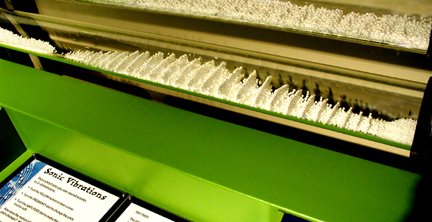
Exhibit built and designed by the WonderLab Exhibit Team led by Don Marvel, Bloomington, Indiana.
