Chapter One: An Acoustics Primer
7. What is amplitude?
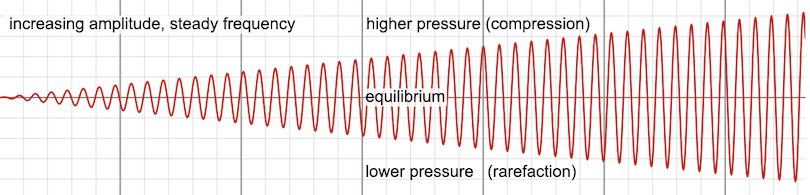
Amplitude (of sound) is the objective measurement of the degree of change (positive or negative) in atmospheric pressure—that is, the compression and rarefaction—of air molecules caused by sound waves. Sounds with greater amplitude will produce greater changes in atmospheric pressure from high pressure to low pressure to the ambient pressure present before the sound was produced (equilibrium).
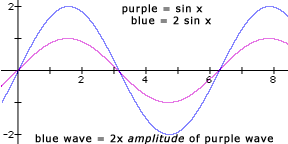
Amplitude is almost always a comparative measurement, since at the lowest-amplitude end (silence), some air molecules are always in motion, and at the highest end, the amount of compression and rarefaction, though finite, is extreme. In electronic circuits, amplitude may be increased by expanding the degree of change in an oscillating electrical current. A woodwind player may increase the amplitude of their sound by providing greater force (blowing harder) in the air column, or a string player may use greater bow pressure, causing a widening displacement of the string to produce a crescendo.

Amazing Factoid #4!
Humans can hear atmospheric pressure fluctuations of as little as a few billionths of an atmosphere, which serves as the benchmark known as the threshold of hearing, discussed later in this chapter. At the other end of the perceptual spectrum, a very loud sound near the threshold of pain may be about a million times the pressure amplitude at the threshold of hearing, yet be only about a 0.03% change in the actual atmospheric pressure at your ear drum. A pressure amplitude change of only 0.001% at your eardrum, if sustained over time, is enough to damage human hearing.
