Chapter One: An Acoustics Primer

6. What is wavelength?
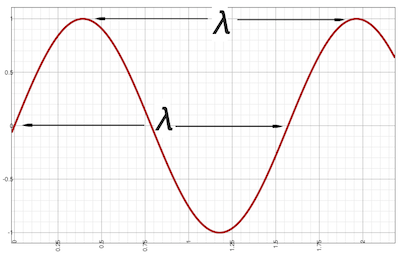
Frequency is directly related to wavelength, which is represented by the Greek letter lambda (λ). Wavelength is the spatial distance required to complete one full cycle of a traveling wave.
The formula for wavelength in air* is:
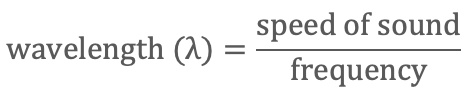
Because a sound wave propagates through space at the speed of sound, these calculations use consistent units (inches, feet, meters, etc.).
≈30.7 inches (≈13,504 inches/sec ÷ 440 Hz)
≈2.6 feet (≈1128 ft/sec ÷ 440 Hz)
≈0.8 meters (≈344 m/s ÷ 440 Hz)
Notice that if the speed of sound changes with temperature, humidity, or propagation medium, the wavelength changes accordingly.
Wavelength is inversely proportional to frequency. In other words, the higher the frequency, the shorter the wavelength. For example, within the human hearing range, a 20 Hz airborne wave has a wavelength just over 56 ft, whereas a 20 kHz wave has a wavelength of approximately 0.7 in.

Wavelength Calculator
Enter a frequency in Hz:
