Chapter One: An Acoustics Primer
6. What is wavelength? | Page 2
Doppler Shift
One particularly interesting frequency phenomenon involving wavelength is the Doppler effect or Doppler shift. You have no doubt seen movies in which a police siren or train whistle seems to drop in pitch as it passes the listener. In actuality, the wavelength of sound waves from a moving source is compressed ahead of the source and expanded behind it, creating the sensation of a higher, then lower, frequency for the listener than the source actually produces. This is the same phenomenon used by astronomers with light wavelengths to calculate the speed and distance of a receding star. The light wavelengths as stars move away from the observer are shifted toward the red end of the spectrum, hence the term redshift, which allowed Edwin Hubble to postulate, in 1929, that our universe was expanding.
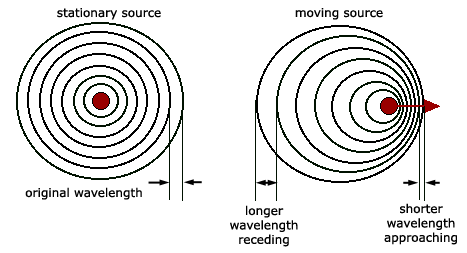
The formula for an approaching sound source is:

The formula for a receding sound source is:

Example using 344 m/s as the speed of sound (v): An oboist in a convertible, traveling at 29 m/s (vsource ), is tuning to A440.
As the convertible approaches your position, you hear ~480 Hz: 
As the car passes and moves away, you hear ~405 Hz: 

DOPPLER AUDIO EXAMPLE:
PASSING TRAIN HORN
click to play/pause
