Chapter One: An Acoustics Primer
7. What is amplitude? | Page 5
Decibels that measure amplitude, microphone voltage, sound pressure, and digital systems
Amplitude can also be measured in decibels with a slight modification that keeps it proportional to the measurement of power discussed previously using the standard reference values for watts and pressure. Since power is proportional to amplitude squared, we can derive the formula (with W = watts and p = pressure):
\[
10\log_{10}\!\left(\frac{W}{W_{\mathrm{ref}}}\right)
= 10\log_{10}\!\left(\frac{p}{p_{\mathrm{ref}}}\right)^{2}
= 20\log_{10}\!\left(\frac{p}{p_{\mathrm{ref}}}\right)
\]
Therefore, the primary difference in measuring decibels pertaining to amplitude, voltage, sound pressure, and digital systems is the use of the multiplier of 20 (instead of 10) and the typical units of measurement. For these measurements, the generic formula would be:
\[ R = 20 \log_{10}\!\left( \frac{A_1}{A_2} \right) \]
By comparing this formula to the one for power ratios on the previous page, the relationship between amplitude, power, and intensity becomes clear. Power and intensity are proportional to the square of amplitude, and the formula above will give identical results for the same amplitude ratios.
For sound pressure, the standard unit of measurement is the pascal (Pa), which as discussed earlier is equivalent to a N/m2. Using the formula above with pressures as micropascals (a micropascal (μPa) = 0.000001 or 10-6 of a pascal), we see that a doubling of pressure from one source to another is equivalent to an increase of +6 dB as shown below. We label this dB SPL because 20 micropascals (20 μPa) is the SPL reference level, as explained below.
\[ 6 = 20\log_{10}\!\left(\frac{2 \times 20\,\mu\mathrm{Pa}}{1 \times 20\,\mu\mathrm{Pa}}\right)\ \left[\mathrm{dB\ SPL}\right] \]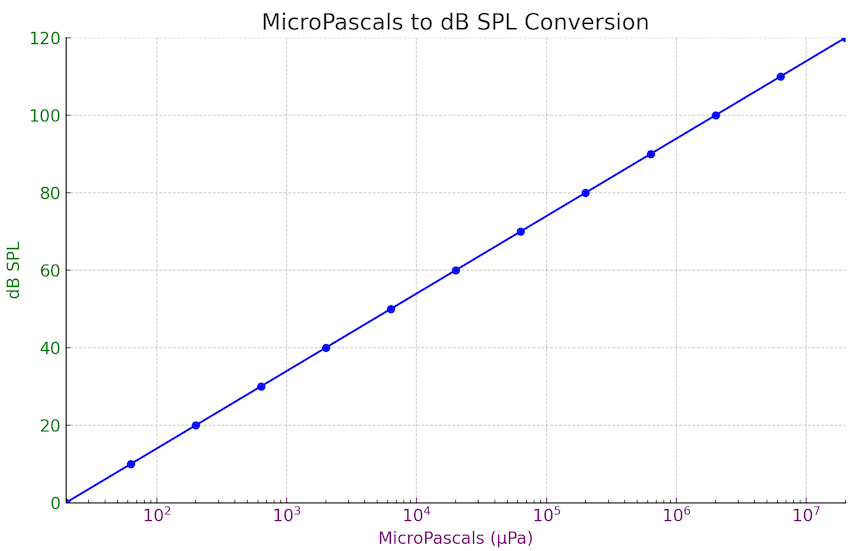
Micropascals – N/m² – dB SPL Converter
Enter one of the values, then click Calculate button to compute the others.
Click Reset to clear all fields.
Review: A doubling or halving of sound pressure, amplitude, or voltage results in a change of approximately ±6 dB, while a doubling or halving of power or intensity results in a change of approximately ±3 dB.
Try it out using the calculator above.
Sound Pressure Level or SPL
As one of the most common acoustic field measurements, SPL measures a current sound level relative to a reference value corresponding to the threshold of audibility, mentioned previously regarding power, but now expressed as a sound field value of 20 μPa (20 micropascals). This absolute measurement is referred to as the sound-pressure level (SPL). It gives us a means of generalizing the relative loudness of common acoustic sources (note that the "dB" is followed by "SPL" to indicate this mode of measurement). The logarithmic scale from the threshold of hearing to the threshold of pain, expressed as intensity, ranges from 0.00002 N/m2 (equivalent to 20 μPa) to 200 N/m2, or about 120–130 dB SPL, at which point the entire body, not just the ears, senses the vibrations. While every 6 dB SPL represents a doubling of amplitude, an inexact rule-of-thumb is that every 10 dB increase is a doubling of perceived loudness (although this is mitigated by other factors such as frequency content, to be covered later).
There is no single established standard for the threshold of pain. In the many references consulted, the threshold of pain ranges from 120 dB SPL to 140 dB SPL, which is a huge variation of opinions and points out the differences between acoustic and psychoacoustic measurement. Younger people also have more effective protection mechanisms and so can better tolerate louder sounds — surprise!
If we accept 130 dB SPL as the threshold of pain, then humans hear sounds that range from the smallest perceptible intensity to those that are 10,000,000,000,000 times stronger or 10 watts/m2. Both the dB and dB SPL scales reflect the incredible discrimination of human hearing, our most sensitive sense by far.
The SPL pressure reference value of 20 μPa and the SIL picowatt/m2 reference value were chosen to keep the proportionality of SIL and SPL as such: Intensity in watts/m2 is proportional to pressure squared (Pa2) when both of these reference values are used. This makes the two correlated columns of the benchmark chart below possible.
Here are some vague benchmarks (which of course depend on many factors, including the listener’s distance from the sound or a particular model of vacuum cleaner).
| Source | Intensity (W/m²) | dB SPL |
|---|---|---|
| Threshold of pain | 101 | 130 |
| Jet takeoff (500 ft) | 100 | 120 |
| Rock concert (50 ft) | 10-1 | 110 |
| Circular saw (3 ft) | 10-2 | 100 |
| Subway (platform) | 10-3 | 90 |
| Jack-hammer (50 ft) | 10-4 | 80 |
| Vacuum cleaner (10 ft) | 10-5 | 70 |
| Normal conversation (5 ft) | 10-6 | 60 |
| Light traffic (100 ft) | 10-7 | 50 |
| Soft conversation (5 ft) | 10-8 | 40 |
| Whisper (5 ft) | 10-9 | 30 |
| Household silence | 10-10 | 20 |
| Breathing (0.5 ft) | 10-11 | 10 |
| Threshold of hearing | 10-12 | 0 |
The Ben and Jerry's Ice Cream Company reportedly funded research on a freon-free freezer that uses sound waves pumped in at an astonishing 190 dB to compress the air enough to bring the temperature down to 0 degrees.
dB Drag Racing is a growing sport in which competitors attempt to produce the loudest sound possible inside a vehicle, which must also be able to run. Wikipedia reports the highest-amplitude in-car sound produced to date is 180 dB SPL—about 64 times the perceived loudness of a jet plane takeoff at 500 feet, and about the same SPL as a police flashbang grenade.
The pistol shrimp creates a collapsing cavitation bubble by quickly snapping its claw that produces an acoustic pressure of 80 kPa (80,000 pascals) and stuns its prey with a whopping 218 dB SPL of sound pressure (it may also cause sonoluminescence)! Plug that into the SPL formula above using the 20 μPa reference!
Microphone levels as voltages measured in dB
Signals from microphones, most of which seek to accurately transform changes in SPL to proportional changes in voltage (V), can also be measured by the same method. You may wish to look at the electricity primer appendix page for a definition of voltage. If one were to change the miking distance to the sound source, the voltage differences could be measured as follows:
\( \Delta\text{dBv} = 20 \log_{10}\!\left( \frac{V_1}{V_2} \right) \)
Decibels in the digital age: dBFS (decibels relative to full scale)
As digital circuitry evolved, a new form of dB emerged in the mid-seventies designated dBFS for full-scale digital. Unlike analog systems, which have a certain degree of "headroom" above their ideal peak level, digital systems do not. There is an absolute maximum peak amplitude quantity that is determined by the number of bits per digital sample. The maximum digital amplitude would be designated as 0 dBFS. The rest of the dBFS measurement is scaled to the dynamic range of the sample size, so that a signal averaging, say, 50% of the maximum value would have a level of -6 dBFS, very much as -6 dB SPL would be a halving of the averaged sound pressure level or voltage differential.
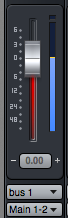
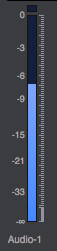
Though the logic of digital audio reproduction is absolute, most manufacturers of digital audio equipment and software such as digital audio workstations (Pro Tools, Logic, Digital Performer) realize that their users either long for the old days of analog VU meters and headroom, or the distorted sound coloring that ensued by overloading tape heads and analog circuits beyond 0 dBVU. They therefore calibrate their software so that the '0' on the fader or meter means approximately -12 to -18 dBFS, and allow users to crank it up another +6 to +18 dB to reach true 0 dBFS as demonstrated below. In fact, many audio recording gurus, such as the legendary engineer Bob Katz in Mastering Audio, tout the ideal music mixing sweet spot at -12 to -18 dBFS average (so RMS, not peak), which is equivalent to 0 dBVU of the past. dBFS meters will often have a -∞ (negative infinity) symbol at absence of signal or silence (see right meter below).
Note the difference between the DP mixing board fader indications on the left (old skool analog SPL indications, actually pertaining to the fader's level, not the signal meter next to it) and the METER BRIDGE meter, which does show the accurate dBFS level of the track's signal. At a level of close to 0 on the mixing board's meter, the true dBFS is more like -6 or -7 dBFS on the METER BRIDGE.
Summary
We have looked at two basic types of dB measurement, one for power and intensity, and the other for amplitude, SPL and voltage. Several other weighted dB scales, such as dBA, are used for specific purposes, such as more closely mirroring the way we hear, but this will be discussed in further detail in the psychoacoustics sections. You may also run into the terms sones and phons at some point in your studies—these are also psychoacoustic measurements, i.e. designed to factor in the way we hear.
