Chapter One: An Acoustics Primer
13. What are standing waves? | Page 2
Room Modes:
Listening and recording environments are extremely susceptible to undesirable standing wave effects whereby certain resonant frequencies are unduly enhanced at certain spots and completely eliminated at others, as mentioned on the resonance page. Hard parallel walls, parallel floor and ceiling, without obstructions, absorption, diffusion, or other treatment make for a playground of standing wave problems, particularly in rooms where one or two dimensions are integer multiples of another (with the worst example perhaps being a cube). Because of the three-dimensional interference, the interactions of reflecting sound waves become extremely complex. Room mode calculators will often list three sets of resonances—axial measures resonance between two opposing surfaces (wall to opposite wall, ceiling to floor), tangential measures resonance between four surfaces (all four walls, or two opposing walls along with the floor and ceiling), and oblique measures resonant reflections that hit all six surfaces. Axial modes, which in a real environment have the least attenuated reflections, are often the most significant and most addressed by planning room size or treatment. However, the other two mode types combined may also pose issues, though individual tangential modes are 3 dB lower, and individual oblique modes are 6 dB lower than the more direct axial modes.
Many online room mode calculators are available. We linked to this one from Trikustik GesmbH earlier. You will see results like this:
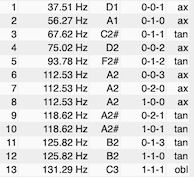
To understand what is going on in the calculation and listing, here is the basic formula used to determine these modes.
p, q, and r represent the mode orders of the resonant frequency for a particular dimension and are usually presented as an ordered list, so using this formula 1-0-0 would represent the first axial mode of the room length, and 2-0-0 would represent the second axial mode of the room length. 0-1-0 would represent the first axial mode of the room width. For a tangential mode, use two integers and one zero, so 0-1-1 would give the tangential mode of the room width and height, and for an oblique mode, use all non-zero integers (such as 1-2-6).
In addition, interactive 3D models are available, such as this Falstad.com one below. If you read the directions of the linked simulation, you can put your newfound knowledge of p's and q's to good use. This simulation shows the interaction of three axial modes — the seventh-order mode along each dimension (7-0-0, 0-7-0, and 0-0-7). The green indicates maximum compression and the red indicates maximum rarefaction (both antinodes), with black being the pressure nodes.
Room Standing Wave Simulation
Simulation created with free Falstad applets at www.falstad.com. Try them!Mitigating Standing Waves in Rooms
It is extremely difficult to completely eliminate all standing waves in a room, but fortunately the main concerns are normally with axial modes below approximately 350 Hz. A more precise threshold, which varies with room size and is often lower, is given by the Schroeder frequency you will find in some of the online room calculators like the one linked above. Many studios employ bass traps in the corners and back wall to absorb specific resonant low frequencies that accumulate at the pressure antinodes. While standard porous traps absorb broadband energy, tunable Helmholtz resonators can also be used to target and absorb these problematic frequencies. Placement of both of these at the appropriate antinode spot(s) is important. Where you locate your mixing desk or listening spots is very important (completely in the corner or exactly halfway back can be dismissed right away). Designing rooms with non-parallel and less reflective walls and with dimensions that are non-integer multiples of each other helps, as do diffusion and absorption panels on the walls and ceiling to a lesser degree, since these are largely ineffective below the Schroeder frequency. Interior barriers such as furniture are of limited help. EQing down problematic frequencies is tempting, but remember, your final product will be played back in other environments. Moving around your room is likely to change your opinion of what needs to be adjusted. Of course, if your budget is up to it, you can hire a professional acoustician with studio experience to design your environment (see well-known designer Russ Berger's site for some awesome studio design eye candy).
Auralex, a company that sells acoustic treatment products, offers an excellent online educational series on studio design and treatment called Acoustics 101, which is worth reading before you set up a studio.
